Project Zebra: Black vistas whose end was deeper than the pit ►
◄ Project Zebra: All cats are (probably) on the autistic spectrum
2025-05-04 📌 Iron Maiden: the next half dozen albums (1986-1998)

Preamble... I know Maiden primarily from nearly thirty years of listening to the two-disc version of their 1996 first best of album plus the classic highly-rated Powerslave. This is me going back to the rest of their albums, particularly those released subsequently. Introduction here and part 1 with the first six albums here.
* * *
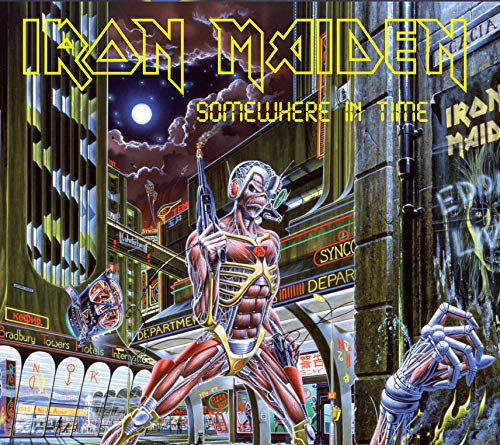 Somewhere in Time (1986)
Wasted Years is on all versions of 1996 compilation Best of the Beast whilst Heaven Can Wait only makes the 2 CD and vinyl. This is another album that doesn't get a huge amount of love from the band themselves, and could be said to lack stand out tracks. It's known for the back artwork containing many in-joke references and recording taking place across a number of countries.
Caught Somewhere in Time opens with the definite feel of a band that have discovered guitar synthesisers, but with Bruce belting out vocals you might not even notice until the solos kick in. It's not entirely unreminiscent of the Transformers the Movie soundtrack and similar hair metal. Wasted Years lays down more familiar Maiden guitars, sans synth, was a single and you can see why with the full sound and finesse.
Sea of Madness has similar guitar barrages and with the intro I'd make a more direct TF:TM soundtrack comparison (Hunger, plus some of Vince DiCola's instrumentals). It's a style I obviously like, although metal it isn't. Heaven Can Wait has a more frantic pace and is an earworm I've enjoyed for years, which meshes several different styles and long parts of the song are without vocals but the rousing chanting and length seem made for live performance. I'd actually be inclined to pick it over Wasted Years.
The Loneliness of the Long Distance Runner sees Maiden going back to mining films as a source of inspiration (summary of this one: a borstal inmate throws a race in protest) but you get the feeling was more about the band being burnt out following the World Slavery tour. Stranger in a Strange Land is another media tie-in and a bit of an odd choice for a single. Dejà Vu almost feels like a fusion with Meat Loaf tracks, which is a comparison that will recur with later albums.
Alexander the Great is a bit more epic, not exactly reaching the heights of Rime of the Ancient Mariner (and not exactly being historically accurate either, apparently) but it plays out more memorably than the rest of the second half of the album. Unlike ancient Egypt or even Coleridge, though, the history is a major gap in British syllabuses of the last forty years, and there's no particularly romantic story, either, particularly to modern audiences for whom imperial land grabs aren't often viewed as a positive thing. It's about a guy who invaded a lot of places that the listener probably doesn't know much about.
* * *
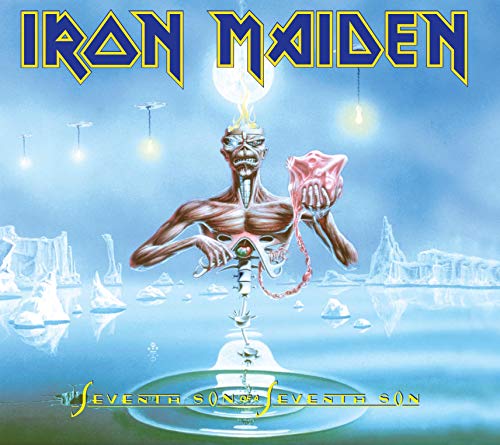 Seventh Son of a Seventh Son (1988)
The 7th studio offering is somewhat concept album-ish and reached UK number one, a position last seen with NOTB. 3 tracks make both the 1CD and 2CD BotB release: Can I Play With Madness, The Evil That Men Do, and The Clairvoyant, with the vinyl set adding the title track. I had fairly high hopes for this since it's a story album. Moonchild holds its own (it's based on Crowley's nonsense) and Infinite Dreams is perhaps a bit self-indulgent and philosophical for a best of compilation (it's on Edward the Great) but works well here in context.
Can I Play With Madness kicks it up a notch, an upbeat chart-bothering track that got mainstream TV and compilation exposure. The Evil That Men Do is a slightly slower chugger but also a strong choice of single. The title track follows nicely on in sequence and I'm enjoying myself despite this being a first listen. In many ways Somewhere in Time is feeling like an anomaly sandwiched between two story albums. Seventh Son also has a mid-run lull that's quite similar to Rime of the Ancient Mariner, before building into an excellent instrumental. I assume the title predates Orson Scott Card reaching prominence more for being a bigoted arsehole than his writing.
The Prophecy is bit more-of-the-same, but it's a good same, like the more filler-ish tracks on Powerslave. The Clairvoyant was a third single, and having been listening to it for years the fact that it isn't quite A-tier material is easily forgiven listening to it in its original context. It doesn't outstay its welcome. Only The Good Die Young has a theatrical staging quality that ties things together, and that's a wrap. Yeah, I think I'll definitely be coming back to this album when in the mood for it.
* * *
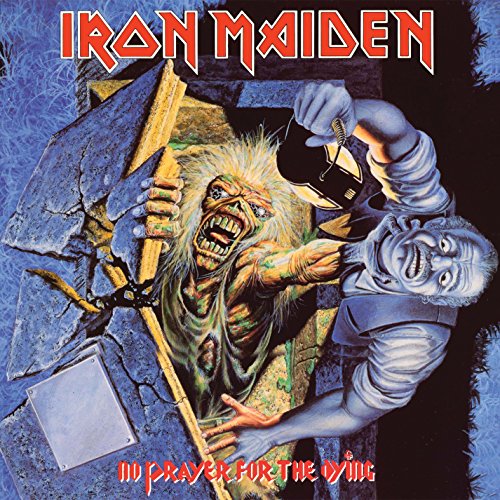 No Prayer for the Dying (1990)
On the 1CD Best of the Beast: Bring Your Daughter... to the Slaughter, and the 2CD adds Holy Smoke, a personal favourite.
There's a bit in the middle of Tailgunner that's a bit Sabbath with the backing vocals. It's a pleasant enough if unremarkable track. Following song Holy Smoke is of course good fun, something that goes for the album as a whole. The band don't seem to be chasing the heights of previous releases and got a bit of a kicking from reviewers at the time for that and a lack of seriousness.
No Prayer for the Dying is a simple laid back number with a mostly instrumental second half. Public Enema Number One offers a similar sound, with a bit of general politics-is-shit-innit commentary. Fates Warning goes back to laid back before getting a bit more driving. The Assassin is the first track that actually feels like filler, and as if it'd be better minus the lyrics.
Run Silent Run Deep takes a turn into submarine war films, apparently one of Bruce's favourites. Hooks in You is apparently about S∧M, but so non-specific and cheerful if there was a video you'd expect a lot of people camply grinning in leather. All this makes Bring Your Daughter stand out when it kicks in, and in fact it stood out at the time enough to reach UK number one, a first for the band. It was released on Christmas Eve in 1990. Maybe it captured a mood, or maybe the BBC banning it generated additional interest. Had it not been released by the band it would've been a solo Bruce number, and it's a bit strange that it's one of their more overtly tasteless songs that got them a hit.
If Mother Russia is political commentary, the vagueness of the lyrics makes it subtle. Of course at the time in Russia Yeltsin was just coming into power, and was on the up in terms of democracy, so thirty-five years on it hits differently (which is to say not at all).
Even if it's not a story album I think this stands up pretty well as gentle background noise, particularly as first time through I was having a listening party with the cat. Moderate alcohol consumption would be a reasonable substitute if you don't have or can't borrow an agreeable pet.
* * *
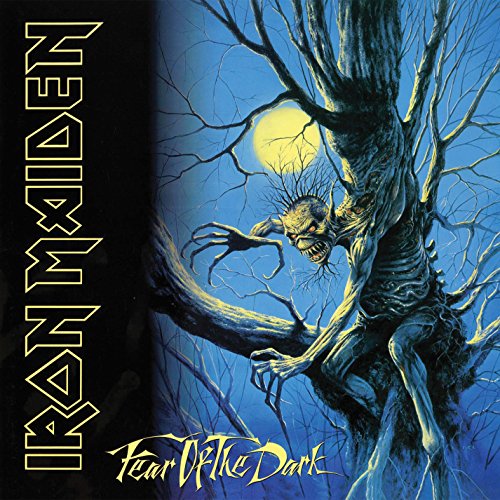 Fear of the Dark (1992)
The 1CD Best of the Beast has Fear of the Dark (but live) and Be Quick or be Dead, with the 2CD adding a live Afraid to Shoot Strangers. Be Quick or be Dead kicks in immediately with more energy than the previous album, From Here to Eternity not letting off the gas much. Bruce seems to be having fun, as do the others. It's clear that despite topping the UK album chart that he needed a break and to chance his arm at solo releases, and music critics harping on about previous releases (despite the album being embraced by the record buying public) probably didn't help.
Afraid To Shoot Strangers sounds better and clearer than the live version I'm familiar with from Best of the Beast. I suppose the chorus doesn't have the same live swagger, but it's still nice to hear and sounds great. What I'm looking forward to, listening now, is the album's title track which gets put on most Maiden compilations but in various different live recordings.
Fear is the Key is about the end of free love with the arrival of AIDS, which had happened about a decade earlier. Musically the instruments sound a bit exotic and the drums stompy. Childhood's End is another political one and a spiritual successor to 2 Minutes to Midnight in lyrics if not quite energy. Wasting Love goes on to lower it considerably more and if you like Maiden ballads you'll appreciate, but it isn't really my cup of tea. The sound is generally better than the previous album, but you can perhaps tell it's another home studio outing.
The Fugitive is another film/TV inspired entry of the sort that the band are quite well-known for by older fans, which works well enough independent of any knowledge of 60s and 70s shows but isn't particularly interesting. Chains of Misery (about intrusive thoughts or a devil on the shoulder) and The Apparition (Dickensian spirit) and Judas be My Guide (?) likewise fail to make a mark.
Weekend Warrior (hooliganism) feels more like a solo Bruce song, not entirely unlike Tattooed Millionaire, which isn't a bad thing after a few more middling tracks. Then we get title track Fear of the Dark to close. It's obviously minus the crowd chanting it usually has live, and takes a little time to warm up, but when it gets going is at least the equal of those versions.
If the album has a problem, it's that you could trim out nearly half of it (or just tracks 6-9) and make a more compelling listen. It doesn't justify a double LP and I have a feeling this will be a theme with later albums.
* * *
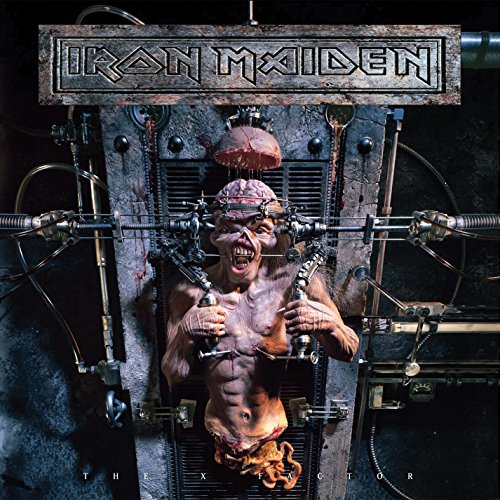 The X Factor (1995)
1CD BotB: Man on the Edge, 2CD adds Sign of the Cross, both also include the non-album track Virus (which as a single got released backed with live versions and covers) - I like Man on the Edge and Virus, and Sign of the Cross whilst not as immediately grabbing has had decades to plant itself in my head. It's actually a real shame that Virus didn't get included on the album as it's meant that years later it's technically out of of print, the internet and wide availability of used copies of Beast of the Beast notwithstanding.
This is another longer album, with a first track (Sign of the Cross) that indulges in nearly three minutes of intro before getting going with another eight minutes of gentle swagger. I don't dislike it, but it's a waste of precious space on a Best Of disc. By a few minutes into Lord of the Flies, Blaze begins to own it, but it's brief before it goes back to focusing on instruments. Still, this is very pleasant. He's not Bruce but is a different type of powerful singer, which familiar track Man on the Edge does a good job of reminding. Fortunes of War goes back to low-key but has some lovely guitar work.
Look for the Truth is very much like Sign of the Cross, whilst The Aftermath detours via the horrors of war. Judgement of Heaven is another track that really suits the new vocalist, with added signature Maiden guitar twirling. Blood on the World's Hands and The Edge of Darkness (latter with Joseph Conrad inspirations) likewise bob along nicely.
2AM gets more ballad-y, before The Unbeliever plays out starting with a similar sort of droning and experimental material that makes following album Virtual XI what it is... it's a chill out album, basically. Nice if you take the last two tracks off the playlist, but a weak and somewhat annoying ending if you listen to a CD all the way through. Doing so brings the album under an hour.
* * *
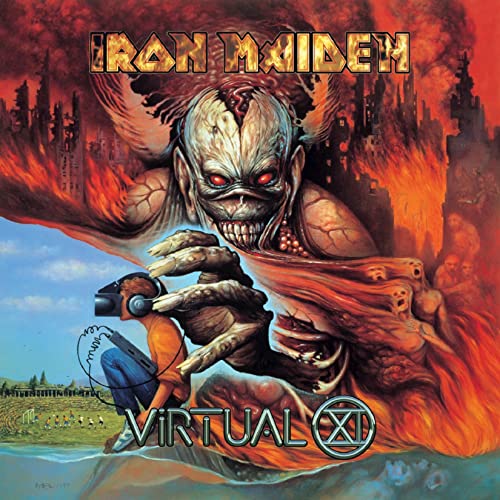 Virtual XI (1998)
At the time (1995-97) apart from Meat Loaf and Iron Maiden I was actually watching TOTP and on the periphery of Britpop and the sort of indie chart compilation albums that had a big boom at the time, but by the time the following album came out I was at college and reading Metal Hammer / Kerrang so a bit more aware.
So I dimly remember this being panned as lacklustre at the time, and coming on the back of X Factor the music press at the time might, not unfairly, be said to have lost some faith in Maiden's ability to turn in memorable listening experiences. It's not an issue with the vocalist, with some enjoyable tracks on that album when it's not being drawn out and po-faced, but the song writing of this era is more miss than hit. Much more miss than hit on this one. Despite this, it should be noted that all eleven studio albums so far made the UK top 10 and Virtual XI got to number one.
Maybe I'd like Futureal more if it didn't hinge on repeating a made up word. It is, apparently, a huge fan favourite as well as the second single from the album. It's a play on futural and apparently about virtual reality becoming indistinguishable from reality, which was an even more laughable concept with technology as it stood a quarter of a century ago, although The Matrix had a more successful go at posing the question the following year and it's obviously been a mainstay of science fiction for much longer. Although the best song on the album I wouldn't have picked it for best of compilations, but at least it's only three minutes long. By comparison, first single The Angel And The Gambler is passable generic rock with extremely repetitive lyrics, the most interesting thing about it being the music video's CGI. And it's nine minutes, which a song has to be really good to justify, and it isn't. Two tracks in the album is already dragging.
Lightning Strikes Twice also has very little substance, feeling like a competent parody of old-school metal. The Clansman has received some live play and nods to Braveheart, making an attempt after a couple of minutes to get into something a bit more rousing but never quite reaching it. The remaining four tracks (When Worlds Collide, The Educated Fool, Don't Look to the Eyes of a Stranger, Como Estais Amigos) are about as memorable. At times the vocals remind me of Meat Loaf, which wouldn't necessarily a bad thing but the lyrics certainly don't have the clout of Steinman on a good day. All the while the guitars underneath sound like a middle-aged pub band that can't quite agreed what sort of music they like, but defaults to twiddling and ballads. There's no fire to any of this and the later tracks particularly plod through the motions.
Virtual XI gives the appearance of having been redeemed in retrospect, as the 2015 remaster has plenty of positive reviews online. I'm not hearing the appeal, personally. I'd been hoping it was just a different style and might click but honestly, if it had been a concept album about the football world cup, something I couldn't give much of a toss about watching other people play but at least would serve as a story hook, it would've been more interesting and saved the sporting event from a weak rehash of 1996's Three Lions.
Rubbing in salt is the fact that the disc of the first copy of this I ordered turned up cracked, so I bought it twice. The original owner was clearly trying to remind me to listen to things online before purchasing. Listeners in the US would also have found that the original release contain an AOL promotion.
* * *
 Bonus album: The Best of Bruce Dickinson (2001)
In the 90s Bruce released five studio albums, a couple of live albums, and has since released a couple more studio albums in 2005 and 2024. The first, Tattooed Millionaire, happened whilst he was still with Maiden. So the 2001 Best Of is representative, and something I previously owned a copy of the 2 CD version of, probably because of the track Tattooed Millionaire being on a favourite compilation plus Balls To Picasso being in a library's CD selection, and subsequently moved on with some disappointment, probably because there was nothing else like Tattooed Millionaire or favourite Maiden tracks.
This was an era I was no longer mostly listening to albums (tapes) and the new thing was MP3s and playlists. And there isn't much here you'd necessarily pick out for a playlist or start singing spontaneously, but it is pleasant as a whole and stands up well against maiden albums of its generation(s) in terms of both vocals and instrumental arrangements. The songs are sung with gusto and the further Bruce goes with solo releases the better the quality is and closer parallels with Maiden when he rejoins them are, including the two new tracks recorded for this release. Silver Wings in particular stands out. You also get quite a mix of styles, Born in '58 being an autobiographical ballad that reminds more than a bit of Bon Jovi.
The second disc includes a track of Bruce spending about fifteen minutes talking you through it, which is probably the most interesting thing there and it's safe to stick to the regular release. Approach it as an album that'll grow rather than be all hits on a first impression and it'll probably reward you.
* * *
Other things that were happening and conclusions
In his downtime from 1986 onwards, Bruce also wrote a couple of comedy novels and I've skimmed the beginning of the first one, which people have digitally preserved, and which seems to draw on the kind of class humour that seemed to characterise British TV more or less throughout my childhood, although less PG Wodehouse and more Upstairs, Downstairs crossed with yuppies and the Young Ones, or some other kind of Rik Mayall vehicle.
At the other end of this period, Ed Hunter was released in 1999 being the title of a simple 3D shooter video game with a tie-in best of collection, the Melt game advertised with BotB having been cancelled or transformed into the one that eventually got released. The songs were chosen by a fan vote.
A question I had in mind listening to this era was whether there were any additional stand out tracks I'd have included on their first best of compilation. Powerslave is the most notable exception, with the six minute 2 Minutes to Midnight being consistently chosen from that album so it's hard to argue it's an omission based on run time like Rime of the Ancient Mariner. I've always assumed it's to encourage sales of the album, but the stand out tracks from Number of the Beast invariably get included. As a track Powerslave does get love live, and it's a fan choice on the Ed Hunter album. Maybe the band just wants people to listen to the fun historical storytelling as a whole, which I can't really fault.
I'm intending to cover the rest of the albums to date in another round up post, already knowing I like Brave New World. Here's hoping that there continue to be pleasant surprises in further uncharted territory. Spoiler: there are. Part 3 is now up here.
💬 Comments are off, but you can use the mail form to contact or see the about page for social media links.
