Project Zebra: Rudolph the RN reindeer is capitalist propaganda ►
◄ Book recommendation: Gathering Daisies in Black Latex Caves
2025-01-31 📌 Iron Maiden: six years, six albums (1980-1985)

I got these as a bundle off eBay from a seller listing tons of period metal albums, so they may not have been split out from a common 15 CD Chinese bootleg set based on the 1998 Extended CD releases. Some context: I've had a 1996 two disc best of album plus the album Powerslave in my collection for decades, and consider myself a fan, but this is my first time listening to any of these others the way they were originally intended by the band... or rather as intended with a bit of tidying up in the late 90s.
Powerslave seems to have been the first Maiden album released on CD in 1984, with the previous four first reissued in 1986. My understanding is that they were fairly straight transfers from the same recordings used for vinyl releases, with a wide dynamic range. In 1995 the albums were released with bonus discs, and in 1998 again with CD-ROM content and without the bonus discs. Remastering on the 90s versions was fairly faithful, and seems mainly a compressor to level the volume to match then-contemporary records, whereas when they were 'remastered' again in 2015 there's a noticeable emphasis on changes that lead to bass rumble and flattened higher frequencies on some tracks. I can't recommend the 2015 versions from what I've heard, so it does rather suck that the easiest way to get earlier versions is bootlegs. Longer introduction here.
* * *
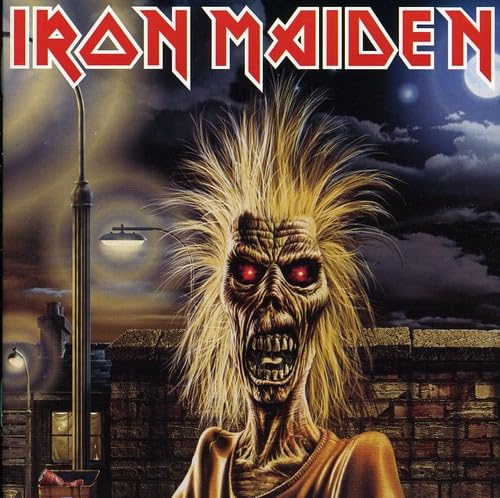 Iron Maiden (1980)
The 1998 edition of the debut includes redone cover art and adds the track Sanctuary (which had already been included on the main album when it was released in the US), with Wikipedia noting that a coda to "Phantom of the Opera" was cut and the intro to "Strange World" was moved to the end of "Transylvania". This messing around with song intros was to become a recurrent thing, and I doubt was done to promote the "whole album" listening experience of tape/vinyl releases and frustrate CD/MP3 users but it's definitely unhelpful. The 2015 re-release omits Sanctuary again.
Five tracks from this make it onto the 1996 2 CD Best of the Beast: Phantom of the Opera, Sanctuary and Iron Maiden, plus a different recording of Strange World and a live Running Free. On the single disc version, only the live Running Free is selected.
Prowler is one of the very earliest Maiden tracks, re-recorded after featuring on the band's first professional demo (aka the Soundhouse Tapes). It doesn't outstay its welcome at under 4mins, but including Sanctuary as track 2 perhaps isn't the best positioning because with track 3 we're back to the more ballad-y / pub band fare Remember Tomorrow. Sanctuary is more of a piece with Running Free, a track I'm more familiar with having a galloping live edge. Here it's simultaneously more punk and slower, but still has its distinctive chugging sound. Bassist Steve Harris really doesn't like punk as a label, and with him having grown up alongside it that's both understandable and you can see why cultural osmosis results in it influencing sound and production.
Phantom of the Opera is the longest track on this album but still a relatively restrained seven minutes. It's carried by playful held note vocals and like Sanctuary I've always liked it. Story songs, light horror themes and guitar solos are the threads that make Maiden. They also do distinctive instrumentals occasionally, with Transylvania a neat bit of guitar wanking and drum work. Strange World continues the tone and goes on full-on prog rock. The start of Charlotte the Harlot sounds a bit too much like Sanctuary to comfortably share an album, before reprising the Strange World sound. Saving possibly the best for last, Iron Maiden is a track that the band has always liked to close out sets with and is one of those songs that like We Are Motörhead functions as a statement of intent. Its positioning on the debut album reminds you that showmanship has always been a trademark of this band.
All-in-all I'd class this as a chill out album probably best consumed stoned, but one you can foresee having a lot of power when select songs are played live with a wall of amps and speakers. It's not metal in the sense of metal I came of age with at the close of the century, and it's no less fun for that. Being honest I don't think I'd have been very impressed back then, but it's definitely something that I appreciate now. It's a likeable beginning and I'm pleased doesn't disappoint.
* * *
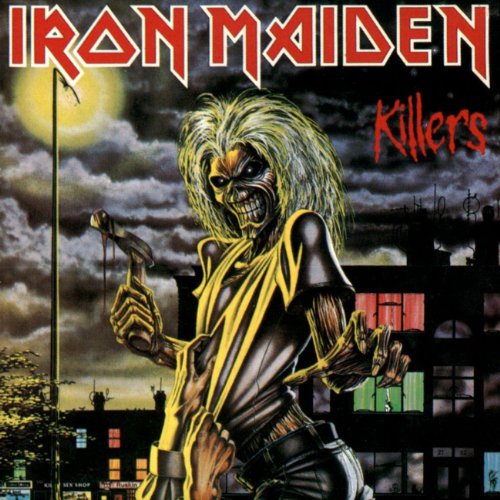 Killers (1981)
This where the tracks get more obscure to me, only one (Wrathchild) making the cut for Best of the Beast and only on the 2 CD version. It includes two short instrumentals, and only Wrathchild gets much play live. It seems to have a degree of second-album syndrome, the band going back to already written material played in the 70s to get a second offering recorded after the healthy success of the self-titled first album.
The Ides of March is the first instrumental, serving as an indulgent but pleasant two-minute intro to the altogether more funk but still laid back Wrathchild (a fun song, particularly if played a bit faster and harder live). Murders in the Rue Morgue steps up the pace with vocals that sound nothing like later Maiden. Like this album in general the production is muddy, but I'd rather have that than edits.
Another Life has echoes of the song Iron Maiden from the first album, with guitar solos that feel a little out of place. Genghis Khan is the second instrumental of the album and from this point on the album starts to sound more like filler that wasn't considered for the debut (although supposedly Papa Roach borrowed part of the song for Last Resort). There are plenty of Maiden guitars and drum sequences, but Innocent Exile, title track Killers, Purgatory, Twilight Zone and Drifter never really get going. It's a jam session rather than something I can imagine rocking out to, although the last two tracks have more of a go and Drifter feels like an appropriate closer. If you only listen to one of the albums before a more classic lineup gets together, make it the first one.
* * *
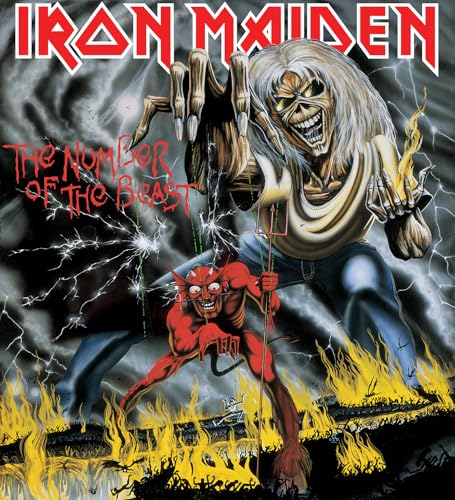 The Number of the Beast (1982)
Considering that Beast was released the very next year after Killers, there's a huge change in styles and production. Opening track Invaders isn't that different with its bass and is apparently a reworking of a 1980 b-side but Children of the Damned sees Maiden phase 2 arriving, lyrics inspired by a British "psychic powers" horror film and letting new vocalist Bruce Dickinson put his mark on things. Only the fact that there are three bigger stone cold classics on the album and reasons of space would lead me to not make it a pick. The Prisoner is also film/TV inspired, with a great long instrumental section. 22 Acacia Avenue goes through several style changes and just about manages to keep it together.
Number of the Beast is a game changer. Paraphrased biblical spoken word intro, tight storyline, polished lyrical and vocal flourishes, driving beat and riffs, glorious sections for air guitar. The sound the band are known for has arrived, and the subject matter worked massively in their favour too, pressing the buttons of idiots in an era of paranoia about backwards hidden messages and satanic panic. Whilst it would have caused some problems touring, protests from people who hadn't understood the lyrics were free publicity. There isn't a backward message on this, although one was slipped into a track on the following album to take the piss.
Run to the Hills was released before NOTB as a single, but sensibly runs on from the titular track as pausing for its spoken word intro would've lost some momentum. Run to the Hills is another stand out track that's every bit as distinctive if not more, with just as distinctive a narrative that's aged well, being very much on the side of the native Americans who were invaded. If you haven't heard either this or the track before it, go do that.
Gangland is yet another story track, apparently inspired by any number of gangster films. On the original album it got picked instead of following track Total Eclipse, but the 1998 release includes both, as does the Japanese one. I have to say I prefer Gangland.
Hallowed Be Thy Name is up there with NOTB and RTTH, and also a rare instance of a song that's been covered as brilliantly as the original (by Cradle of Filth). All three are gems that feel like they're written by a band several years ahead of the rest of the album in terms of proficiency and tightness, and belong on any best of, including both CD versions of BotB. This isn't as charging as the other two, but isn't trying to be for most of its length; it has a deliberateness and rhythm that pairs with an economical guitar solo you'll remember forever. Dickinson sees it out with a rousing crescendo.
Do you need this rather than a best of compilation? Probably not, but it's an interesting listen.
* * *
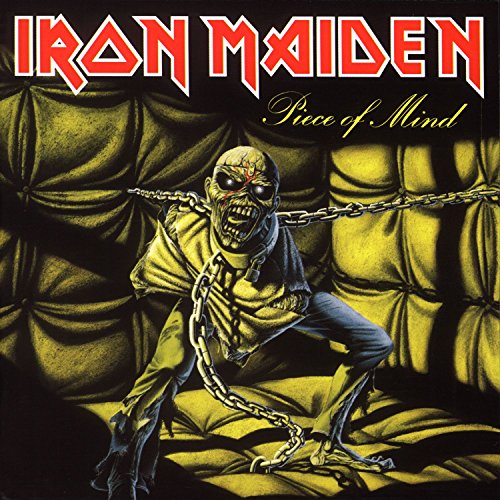 Piece of Mind (1983)
This is the point at which Nicko joins the band. The Trooper makes both versions of BotB and the 2 CD also selects Where Eagles Dare, which is similar to Aces High on following record Powerslave.
The album feels as if it doesn't particularly have a unifying hook, partly because there isn't a title track. If there was, the album would probably have been titled The Trooper, and tracks such as Where Eagles Dare and the titles of others (if not the lyrics) would suggest it's about war. In reality it's a mash-up of history, films, fiction and anything else that interested the band, like their others.
Revelations has all of the ingredients of a Maiden song but I think could stand on its own as an instrumental, most of it being showing off and having fun with the new band line-up. Flight of Icarus was released as a single and selected for later best of album Edward the Great, and whilst it's grown on me like most recognisable story songs there's again more stand out instrument-bothering than particularly great lyrics. Die With Your Boots On, despite the title, is more about the Cold War and FUD than all-out war, and another one where the instruments carry things.
The Trooper breaks the run, even if I've never thought it was in the running for best song or about the Charge of the Light Brigade. It's got the driving rhythm and finesse of tracks from TNOTB and a sound basis for being a live favourite. Still Life has the backwards message intro referred to earlier, Nicko doing an impression of John Bird doing an impression of Idi Amin and the message being "don't meddle with things you don't understand". It, Quest for Fire, Sun and Steel and To Tame a Land are pleasant and non-essential, which might as well be the album's capsule review, although it did well with Kerrang! readers back then. (To Tame a Land is about Dune and caused the band to get into spat with Frank Herbert, who didn't like the idea of them.)
* * *
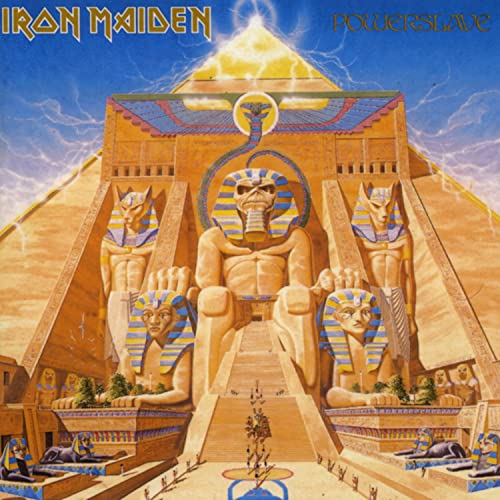 Powerslave (1984)
Onwards and upwards. I first heard this in the 90s at an age I was just starting to pay attention to music, and the inlay artwork was a real draw. It was done by Derek Riggs (who also created the band's mascot) and fans have commented it bears a resemblance to the artwork for the 1977 album All 'n All by Earth, Wind & Fire. Both are inspired by the Abu Simbel temple, ancient Egypt having fascinated people and bands for centuries. Powerslave also has the corresponding view outwards from inside the pyramid as the back cover, and Riggs says he copied the hieroglyphs from an historical text and apparently they're praising Osiris as all-powerful.
It's one of several gorgeous pieces done for the album and singles: https://ironmaiden-bg.com/web/index.php/the-powerslave-artwork
I very quickly grew to love the album although, despite the strong visual, only the title track is directly inspired by ancient Egypt, which I recall being a bit disappointing initially. Maiden draw widely from films, literature and history but at this point hadn't done any story concept albums... however, ending this one with a nearly 14 minute track based on Coleridge's The Rime of the Ancient Mariner (published in 1798) keeps the ancient history angle. Plus it's a genuinely educational epic, albeit introduced live with "the moral of this story is, this is what not to do if a bird shits on you..."
So... eight tracks, none of which are under four minutes and almost all of which are straightforward barn-storming rock. Aces High and 2 Minutes to Midnight are thematically similar and centre the history on the C20th. Losfer Words (Big 'Orra), being an instrumental, you might think might have been a choice to omit for the purpose of getting the ~51 minute album onto one side of a 90 minute cassette, but it was one of the next three tracks, Flash of the Blade / The Duelist / Back in the Village, specifically The Duelist. Two of those are about sword fighting (so being a fan of Highlander that was the association) and the village in question is apparently the one in British TV classic The Prisoner... not a reference I'd have noticed (and I've never felt the urge to watch it) so I assumed it was another war-themed song, like the first two on the album. The band apparently also aren't particularly fond of these three. But if they're filler, they're still very listenable.
That brings us to the title track, which couldn't be more perfect with its opening of heavy footsteps leading up to chugging guitars, followed by an even longer story track to go out on. The only irritation in this release is the intro being cut off and stuck onto the end of the track before it. If you want one of the earlier CD releases they're not too hard to find on eBay and i couldn't resist picking one up. Along with Meat Loaf's Bat out of Hell 2 this is one of the defining albums of my early teenage years, far more than Britpop.
I have such a massive amount of affection for this that along with the two-disc best of I heard at about the same time, presumably stocked due to Maiden being at their height and requested a lot by library patrons, that I didn't dig very far into the rest of Maiden's catalogue. I figured it'd be a disappointment (another library had at least one live album, I think including A Real Live One, that added to that impression, which with the hindsight of thirty years still generally don't grab me as much as studio recordings). Was that the right decision? I appreciate the other albums now with age, and they've settled in quickly, but you can't go wrong with the three discs I started with and the only track I feel got a bit hard done by on other compilations is still Holy Smoke.
As a coda I want to mention Maiden's approach to releases... when Powerslave was reissued in 1995, like other reissues it got a disc of bonus tracks that have been absent from the 1998 and 2015 remastered editions. All told there are currently 100 separate CD releases of the album listed on Discogs and some albums have more (although most of these will be from particular masters). The sheer number remind you it's hard to overstate how huge Maiden were in the 80s or how big a part of music culture in general in the UK and elsewhere. And also that Maiden have always tweaked things and made changes as they went along. It's not revisionism per se, they just do what they think is best at any particular time.
Speaking of which there was actually a vinyl release of BotB that has 7 tracks not on the 2 CD - a live Revelations, The Prisoner, Killers, Remember Tomorrow, Prowler, Invasion and Seventh Son of a Seventh Son. Not particularly what I'd have picked with space for seven extra tracks. Powerslave itself is an obvious omission and I think it would have been nice to include a side of the band's instrumentals.
By the way, if you want more knowledgeable breakdowns of each song on every album I'd recommend http://www.ironmaidencommentary.com/
* * *
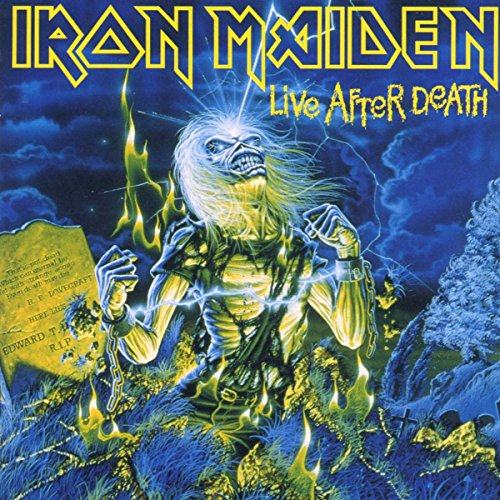 Bonus album: Live After Death (1985)
The capstone on this five years was the band's best known live album. The original release was abridged on CD, 13 tracks recorded at Long Beach Arena, with the 1998 2 CD release (like the vinyl) including live recordings of five less well-known tracks from a different gig at the Hammersmith Odeon. The album is notable for including the Churchill's speech intro to Aces High (always a live favourite opener), gets very good reviews, and establishes mainstays of the band's live set that also usually make it into best of collection track choices. Apparently it also got the band some time off to recover after the huge World Slavery Tour before going back into the studio. I don't mean to listen to or review all of the band's live albums, but this is an important one and at the time would have served as an early form of best of album.
Live, the band were very close to reproducing their 1984 studio sound. A bit more energetic at times (Flight of Icarus sounds better, Rime of the Ancient Mariner is the version that graces Best of the Beast) but if you usually don't like deviations from recordings you know, Live After Death is unlikely to ruffle feathers. In the 1998 edition, Running Free includes crowd participation whereas a shorter edit was used for the original release and on Best of the Beast. The title track from Powerslave makes an appearance. The earlier songs generally benefit from their greater experience. The longer tracks sound just as vital as when more produced. The main set as a whole makes itself immediately at home in your head and is well worth a spin.
The next five albums (plus a single) will take the band up to the release of Best of the Beast in 1996, see them expand their repertoire into using synthesisers, and for the last of those albums see a temporarily departing Bruce Dickinson replaced with Blaze Bayley. Also, Bruce will write a book or two. Part 2 is now up here.
💬 Comments are off, but you can use the mail form to contact or see the about page for social media links.
