Victorinox releases a load of new tool designs/models ►
◄ Project Zebra: Tablets, updates, Windows, oh my

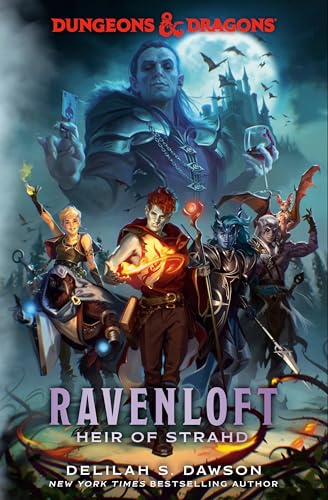 Okay, I liked this. I think it'll be dismissed in some quarters as pablum in the same way Doc Savage or other pulps would have been a hundred years ago, or when swords and sorcery fantasy was huge* circa the 80s, but that if available to a large enough audience (that wasn't terminally online or otherwise distracted or time poor) might find similar reactions but also a similarly minded and sized fan base. Some people always look down on genre fiction, or tie-in fiction, or YA fiction, or just fiction, and Heir of Strahd qualifies as all of those things. However, audience fragmentation aside, because Dungeons and Dragons is in something of a renaissance, I'm not sure what percentage of newer audiences mainly drawn in by the Baldur's Gate 3 game will try new or old novels, or even play D&D as a TTRPG.
*For context, I was reading Fighting Fantasy, game tie-in fiction, Dragonlance, etc, at primary school, and things like Conan, Willow, MOTU, HeroQuest and Tolkien were cultural touchstones.
For a change I'm going to keep a review mostly spoiler-free. Amazon has a sample to skim.
If you like author interviews, I listened to this before reading the book and read this and and a few other bits, or Dawson is an occasional blogger and seems to be on Bluesky and Threads amongst other places. Other properties she's written for that I recognise include Star Wars and Hellboy. NYT best selling author, ND, etc. Seems like a decent sort and clearly interested in the history of the game.
Ravenloft is a horror flavoured adventure setting, so think vampires (like here) and other 'classic' scenarios like Frankenstein or Invisible Man or Jekyll and Hyde analogues, werewolves, mummies, other undead, or just human bluebeards and tyrants. This often leads to tone clashes between different types of horror, or characters dropped into horror scenarios from more 'normal' swords and sorcery. It sometimes has a more modern frame of reference (up to about Victorian era) but mostly it's fantastical medieval, with an emphasis on the gothic and supernatural, and players may not have access to as much magic as in other settings.
If you're reading about Ravenloft, Wikipedia has separate articles on its original 1983 adventure and the setting that developed from it from 1990 to now, plus the 2016 campaign setting that this commissioned novel takes as inspiration and was written to help market.
The characters are a deliberately low level party, possibly level 2 or 3, and I suspect gain levels during the story. Beyond that I couldn't guess. 5e DnD seems to be quite removed from the first few editions of AD&D I'm familiar with, and I haven't read those rules (yet) so I don't know e.g. what counts as a cantrip, how many spell slots are available at each level, or how easy it is to acquire new spells. I also assume that there was some range of levels across the characters, simply because some have survived some sort of careers involving fighting prior to the book. Apparently Dawson did create character sheets and spell lists, and mentions there's a possibility they might be made public in future.
It's an eclectic bunch to drop into a horror setting. Some of the character decisions were by Hasbro/WotC, such as including a kenku cleric (humanoid bird). Apparently in the game, kenku are flightless mimics (communicating by piecing together speech from heard sounds, rather than anything to do with the monsters known as mimics that morph into treasure chests etc). I didn't notice that trait, assuming the character was just shy or relatively unfamiliar with human Common language, although the yearning for wings came across clearly and the references to the pantheon of the Forgotten Realms by various characters seemed in keeping with my experience of that setting. The rest of the party being a tiefling paladin, orc wizard, drow barbarian and human artificer (plus a hairless tressym) wasn't particularly jarring. Not seeing the cover after I started reading I didn't imagine any of the characters as pictured there, though. I don't recall if the tiefling's skin colour was mentioned, so I figured that horns and a tail would feature and had a mental image of red, and I assumed the orc was a half-orc because being older than the setting and never playing World of Warcraft orcs look like the miniatures in original HeroQuest. Occasionally they might have protagonist roles in books, such as Vrakk in James Lowder's Prince of Lies, but I don't think of them as just green humans with tusks. Anyway, I suggest not getting too hung up about the cover art, which doesn't match the tone of the novel any more than I felt it accurately depicted the characters. It's analogous to clickbait.
Positive reviews I've seen generally like the sense of fun, random party makeup, game-session like elements and recognisable references to the adventure campaign setting it's based on. Negative reviews want Ravenloft books that are more like the ones published in the 90s, more horror included, or found a bit of the language seemed incongruous with the setting and too real-world (I wouldn't argue with the last point). Both positive and negative views have included reference to Critical Role, and I think fans of The Legend of Vox Machina would tend to enjoy the book.
I don't think it's going to matter too much if you're a DM running Curse of Strahd and your players read this. It's not written with the intention of revealing lots of lore or adding to it. In particular, it won't spoil new low-level parties as the characters skip fairly quickly to being targeted by Strahd and ending up at the castle. They might note the existence of a magic item or secret door or two, but nothing unbalancing. Also, there's nothing to say that a DM has to run a game RAW (Rules As Written). There is a bit of meta on the nature of the demiplane, Strahd being in a Groundhog Day loop situation with his obsession Tatyana and darklords in general being defeated but coming back, which depending on how purist or secretive you're trying to be about a module that's existed in various forms for over 40 years, I suppose you might not want players to dwell on too much.
Over the years I think I've read campaign materials for every version of Ravenloft from the original to present, and a majority of the previous novels. I don't particularly think of Strahd as a character (and the same with other characters such as Van Richten, Rahadin and Pidlwick) but more as tropes, ideas and mechanics that people will choose to put different spins on. If you've only read Vampire of the Mists, Knight of the Black Rose and the I, Strahd books and have that version of Strahd in mind rather than the guy depicted on the cover of the most recently published game stuff, or hate the modern game entirely, Heir of Strahd isn't aimed at you.
The story's relatively short, and there’s not much scope for exploring a whole campaign in ~300 pages. I was wondering, particularly towards the end, how things were going to be drawn towards a conclusion, or whether it was headed for a cliffhanger. Indeed, the ending is somewhat cinematic in a cut to black sense, although it sets the reader up well to imagine what happens next with further adventures that aren't necessarily in the Mists. I rather liked the "final battle" scene, and how that was handled, with one of the characters getting to put into practice their own plan rather than simply being rescued.
In terms of tone it's neither excessively cheery nor grimdark and Break The Cutie — all of the adventuring party get some development and sympathetic moments, even if they begin standoffish, and the reasons for each being swept up into the Domains of Dread and thrown together with random strangers are touched on.
So this is Ravenloft as a one-shot or a few sessions, and it's Ravenloft rather than just Strahd's domain with the side quest into modern style Lamordia. It'd be hard to give more plot points without major spoilers, but I enjoyed it a lot more by the second half when it became apparent that the characters had a fair amount of plot armour and gelled as a group, with a decent amount of creative ideas and some humour. Overall, I'd draw parallels with the recent Honor Amongst Thieves film, which I liked and for similar reasons. The result is a tale well suited to younger readers whilst still being fun for older ones who were alive when Ravenloft was first published. Do give it a shot if escapist fantasy is your sort of thing at all.
💬 Comments are off, but you can use the mail form to contact or see the about page for social media links.
